eco-1002 · Money and monetary policy
The Fed's Balance Sheet and the Money Supply
How the Federal Reserve's assets and liabilities determine the monetary base, and how that base is multiplied into the broader money supply through bank lending.
Learning objectives
- Explain the relationship between the Fed's balance sheet and the monetary base.
- Derive the equation for the simple deposit multiplier and use T-accounts to illustrate multiple deposit creation.
- Explain how the actions of banks and the nonbank public affect the money multiplier.
The Fed’s balance sheet
The Federal Reserve, like any bank, has a balance sheet. Its assets are primarily Treasury securities and (since 2008) mortgage-backed securities. Its liabilities are currency in circulation and bank reserves. Together those two liabilities form the monetary base, often denoted or :
When the Fed buys $1 billion of Treasuries on the open market, it pays with newly created reserves — both sides of its balance sheet grow by $1B. The monetary base rises by that same $1B. This is the central fact that makes the Fed’s open-market operations a monetary-policy tool.
From base to broad money
The monetary base is small. The stylized deposit-multiplier model below describes transaction money — currency plus checkable deposits, an M1 proxy — because bank lending creates deposits. It is not a structural model of M2. For that stylized aggregate, the ratio of to is the money multiplier :
In the simple case where banks hold a fraction of every deposit as reserves and the public holds no currency, repeated re-lending gives the simple deposit multiplier . With , $1 of base creates $10 of deposits.
The realistic money multiplier
Two leakages shrink the multiplier:
- The public chooses to hold some currency. Let be the currency-deposit ratio.
- Banks hold some reserves beyond what’s required (excess reserves). Let be the total reserve-deposit ratio.
The full money multiplier is
Both leakages reduce . After 2008, rose dramatically because the Fed began paying interest on reserves and banks chose to park excess reserves there instead of lending. The multiplier fell, so even though the Fed expanded enormously (quantitative easing), the deposit-multiplier channel weakened substantially.
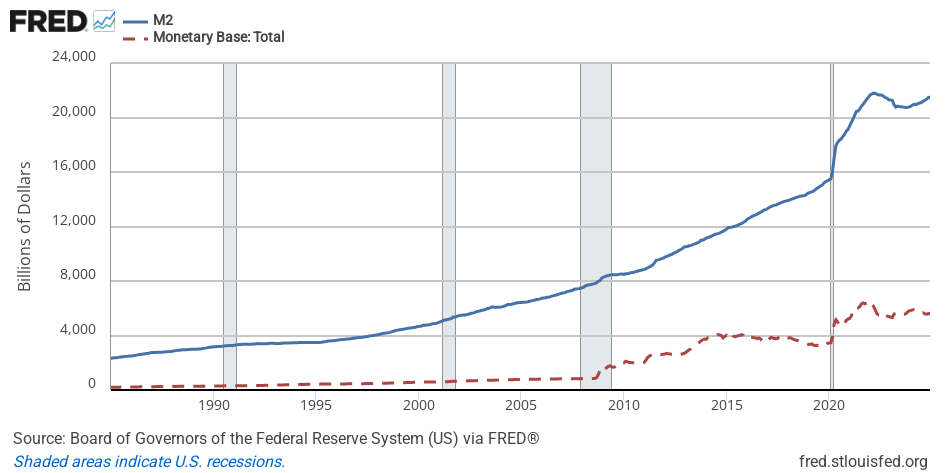
Play with it
This stylized transaction-money model uses M1 = m · MB where m = (1 + C/D) / ((C/D) + (R/D)). As banks hold more excess reserves (R/D ↑) or the public holds more cash (C/D ↑), the multiplier shrinks. It does not model M2, whose ratio to the monetary base is a descriptive aggregate rather than this deposit-multiplier identity.
Try raising from 0.10 to 0.30. Notice that the multiplier roughly halves — that’s the QE-era story in one chart.
Where the policy lever is
The Fed uses open-market operations, discount lending, and its balance sheet to influence the supply of reserves and therefore the monetary base. The realized base also reflects currency demand and bank borrowing. The Fed influences indirectly through the interest rate it pays on reserves. It does not control — that’s a household choice driven by trust in banks and the cost of holding cash. This division of control is why monetary-policy transmission can be slow and uncertain.