eco-1002 · Long-run growth
Saving, Investment, and Crowding Out
The loanable funds market: how the real interest rate clears saving with investment, and how government deficits compete with firms for the same pool of funds.
Learning objectives
- Describe supply (saving) and demand (investment) in the loanable funds market.
- Explain how a government deficit shifts the supply of loanable funds.
- Define crowding out and quantify it for a simple deficit shock.
The market for loanable funds
When a household saves a dollar, that dollar is supplied to the market for loanable funds (through banks, money market funds, or bond purchases). When a firm wants to build a factory it demands loanable funds (by issuing bonds, taking out a loan, or selling equity). The real interest rate is the price that clears this market.
Demand for loanable funds is investment , which falls as the real rate rises. Supply is national saving: private saving plus government saving (a deficit is negative government saving). Saving rises with because the reward to deferring consumption is higher.
Crowding out
Suppose the government runs a $300B deficit. National saving falls by $300B before households respond — the supply curve shifts left. The new equilibrium has a higher and lower . If the higher rate induces $X of additional private saving, national saving and investment fall by $300B minus $X. That remaining decline is the amount of private investment crowded out.
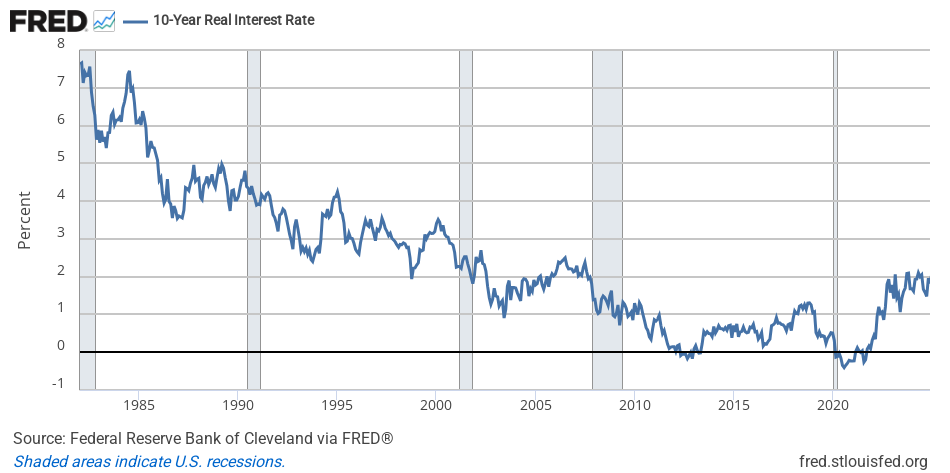
Current parameters: deficit = $0B, private-saving multiplier = 1.00x, and investment-demand multiplier = 1.00x. The calibrated slopes are bI = 30 and bS = 25 billion dollars per percentage point. The axes expand to include the clearing rate, including a negative real rate when strong saving or a surplus requires one. A government budget deficit (positive value) means the government is borrowing from the same pool of saving that firms use to invest. That shifts the supply of loanable funds left, raises the real rate, and reduces equilibrium investment — crowding out.
Try setting the deficit slider to $300B and watch the equilibrium move. Note how much of the deficit is absorbed by extra private saving (the new is higher) vs how much crowds out investment.
Why it matters for the economy
In the long run, investment becomes the capital stock that drives growth. A persistently large deficit means persistently less investment, which means a smaller capital stock and lower productivity than the economy would otherwise have. This is the long-run cost of deficits — separate from short-run cyclical effects.