fin-3610 · Time, money, and interest rates
The Time Value of Money
Three rules of time travel: discount the future, compound the past, never add cash flows from different dates. The single most important computational skill in finance.
Learning objectives
- Apply the three rules of time travel to a single cash flow.
- Compute present value (PV) and future value (FV) given a discount rate r and horizon T.
- Use the Rule of 72 to estimate doubling times in your head.
A dollar today vs a dollar tomorrow
You can earn interest on a dollar you have today. A dollar promised next year can’t earn interest until you actually receive it. So a dollar today is worth more than a dollar tomorrow, even ignoring inflation, default risk, and your patience.
The exchange rate between dollars at different dates is the interest rate . Specifically, if the one-year interest rate is :
- $1 today = $(1 + r) next year (compounding forward).
- $1 next year = $1 / (1 + r) today (discounting back).
Everything else in TVM is just iterating this rule across multiple periods.
The three rules of time travel
Berk and DeMarzo state these as three numbered rules. They are easy to memorize and impossible to violate without making a finance mistake.
Rule 1. Only cash flows at the same point in time can be compared or combined. Adding “$100 today” to “$100 in five years” is meaningless until you’ve moved one of them to the other date.
Rule 2. To move a cash flow forward in time by periods, compound it:
Rule 3. To move a cash flow backward in time by periods, discount it:
That’s the entire toolkit. Every multi-period NPV calculation is just Rules 2 and 3 applied repeatedly and Rule 1 applied to sum the results.
Play with it
Cashflows by year
NPV sensitivity to discount rate
Current parameters: CF₀ = $-1000, first annual cash flow = $250, growth = 3.0%, r = 8.0%, and T = 8 years. Cash flows grow from the year-1 base and are discounted at the same rate shown in the sensitivity chart.
Set CF₀ to 0 and the base annual CF to $100 with growth = 0. The right-panel “NPV(r)” line shows how PV changes with the discount rate. Drag from 2% to 15% and watch a flat $100-per-year stream’s PV halve as doubles.
A few worked examples
Example 1. You’ll receive $1,000 in five years. Discount rate is 6%. What is it worth today?
Example 2. You invest $5,000 today at 8% for 10 years (annual compounding). How much do you have?
Example 3. Your friend offers you $500 today or $600 in three years. Which is better if you can earn 5% on safe investments?
Move both to today’s dollars:
- Option A: $500 (already today).
- Option B: $600 / (1.05)^3 = 600 / 1.1576 ≈ $518.30.
Take option B; it’s worth about $18.30 more in today’s dollars.
The Rule of 72
A useful mental shortcut: at interest rate (in percent), an investment doubles in approximately years.
- At 4%: doubles in 18 years.
- At 6%: doubles in 12 years.
- At 9%: doubles in 8 years.
- At 12%: doubles in 6 years.
This is exact within 2-3% for rates between 4% and 15%. Useful for quick sanity checks: “If my mutual fund averages 7%, it should double roughly every 10 years.”
When does change?
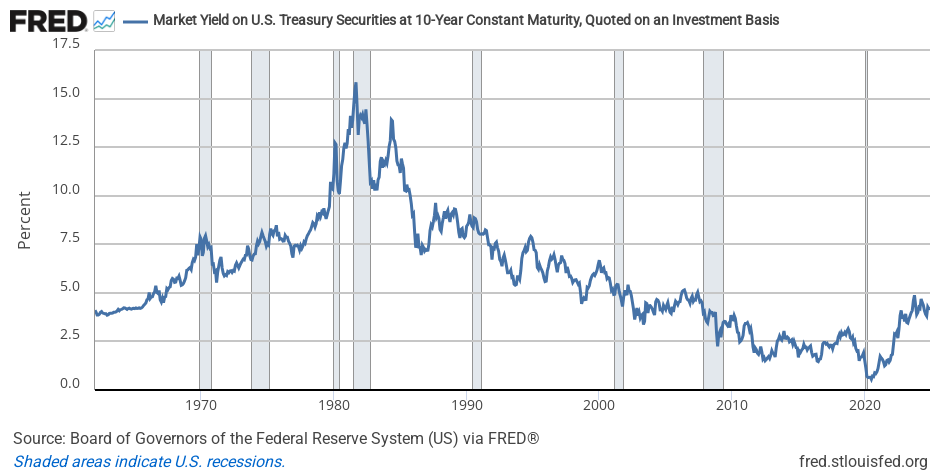
In the basic TVM setup, we use a single rate for the entire horizon. In reality interest rates differ by horizon (the yield curve, covered next lesson) and by risk (the cost of capital, covered in Unit 4). The mechanics of compounding and discounting don’t change; only the choice of which to plug in changes.
The discipline: never write down a future cash flow without also writing down the date it occurs on. Date-mismatched cash flows are the source of nearly every preventable TVM mistake.